


How to prevent fake signups on your Shopify store
Mon, 3rd Aug 2026
Every discount popup on your Shopify store is an open invitation, and not just to real customers. Bots and coupon hunters treat first order signup forms as free money, and by the time you notice, your Shopify customer database is padded with addresses that will never open a campaign or place an order.
Email remains one of the highest ROI channels in eCommerce marketing, which is exactly why list quality matters as much as list size. Industry estimates put email marketing ROI at $36 to $40 for every dollar spent, but that return only holds if the addresses on the list actually belong to real, engaged people. Poor quality data drags that number down fast: higher bounce rates suppress deliverability, and low engagement rates signal to inbox providers that a sender isn't worth prioritizing.
The fix isn't another captcha or a cleanup sprint every few months. It's Shopify email verification at the point of signup, before a bad address ever reaches Klaviyo, Postscript, or the customer database itself.
Why Shopify Signup Forms Attract Fake Customers
Discount signup forms reward visitors instantly, which is exactly why bots and manual abusers target Shopify stores running them. Disposable email usage is common enough that some estimates suggest a meaningful share of eCommerce signups involve temporary or throwaway addresses, most of which never convert into a repeat customer.
Automated scripts submit Shopify signup forms repeatedly using rotating fake names and throwaway addresses. Some merchants have found thousands of fake accounts traced back to a single script cycling through a small set of reused identities. None of these convert. They exist purely to farm discount codes.
Disposable email services compound the problem. A visitor can spin up a working inbox in seconds, use it to claim a discount at checkout, and abandon it permanently. Shopify's native customer accounts flow has no built in way of knowing the domain was never meant to last past that first order.
Then there are the manual coupon hunters, real people gaming Shopify discount code abuse rather than bots. Gmail's dot trick and plus addressing let a single shopper generate a dozen "unique" accounts from one inbox, each one claiming the same discount a store's margin can only absorb once.
If a store also collects phone numbers for SMS marketing, the damage extends further. Mistyped numbers and VoIP lines that were never meant to receive texts quietly burn through SMS credits with every send.
Signs Your Shopify Store Has a Fake Signup Problem
A few patterns tend to show up before merchants realize how deep the issue runs:
• Subscriber growth that doesn't match order volume
• High coupon redemption paired with low repeat purchase rates
• Rising email bounce rates month over month
• A cluster of accounts from the same disposable domains
• Consistently low open and click rates despite list growth
• Multiple accounts with near identical or slightly varied names
Any one of these alone might be noise. Several appearing together usually points to a Shopify customer verification gap at signup.
Why Cleanup After the Fact Doesn't Solve It
Most merchants treat this as a maintenance problem: export the customer list from Shopify admin, filter out accounts with zero orders, delete the obvious junk, repeat monthly. That keeps the list tidier, but it only removes damage that has already been done.
By the time a fake signup shows up in an export, it has already inflated the subscriber count, skewed the store's conversion rate, and possibly triggered a discount code redemption. Cleanup catches the symptom. It doesn't stop the entry point.
Validate Shopify Signups Before They Reach Your Customer List
The more durable fix is checking each email address in real time, at the moment someone submits the signup form, before it's added to the Shopify marketing list or synced to a marketing platform.
A real-time Shopify email validation check can catch what a signup form alone cannot:
• Syntax errors and typos a human would never notice at a glance
• Domains with no valid mail server behind them
• Known disposable and temporary email providers
• Role based or catch all addresses that will never engage with a campaign
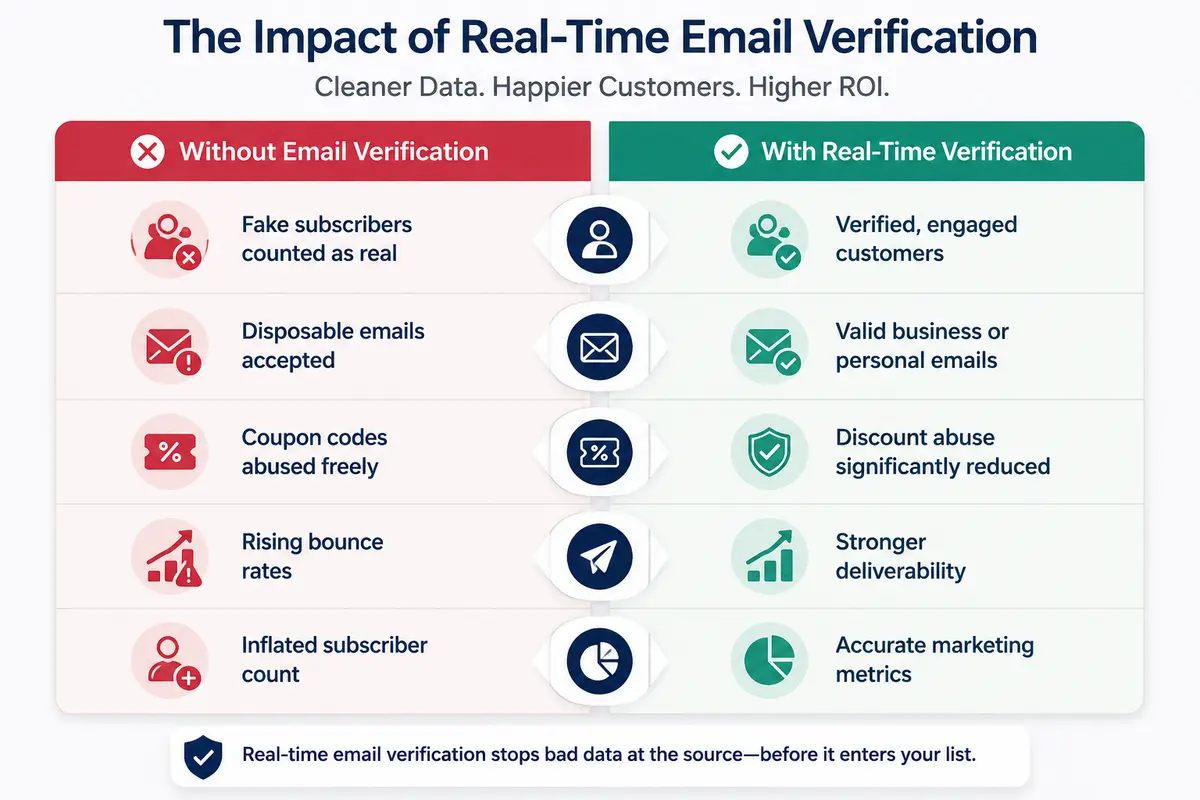
This isn't the same as a spam blocking captcha, which mostly filters obvious bot behavior. Shopify already layers in some bot protection by default, but a real person can still type a fake or disposable email straight through it. A real-time check like this validates whether the specific email being submitted can actually receive mail and belongs to a real, ongoing domain, which is what stops the coupon hunters and disposable-email crowd that captchas let straight through. When this runs as part of the signup flow, a bad address gets flagged or blocked before a discount code is ever issued and before it counts toward the subscriber total.
Shopify merchants typically implement this through custom app integrations, middleware platforms, or APIs that validate customer information during account creation, newsletter signups, or checkout, without needing to rebuild the signup form itself.
How Email Verification Protects Shopify Revenue
The cost of unfiltered signups rarely shows up as a single line item on a Shopify dashboard, which is exactly why it goes unnoticed for so long.
Every fraudulent discount redemption cuts directly into margin, and once enough of them pile up, the reported discount rate stops matching what the books actually show at reconciliation.
Sender reputation takes a quieter hit. Sending campaigns to dead or fake addresses drags down deliverability scores across the entire account, which means even real subscribers start missing emails they'd otherwise open.
And every metric downstream of the subscriber count inherits the distortion: conversion rate, cost per acquisition, even inventory and ad spend decisions that get built on numbers that were never accurate to begin with.
Best Practises for Preventing Fake Shopify Signups
Fixing this doesn't require rebuilding the Shopify signup flow. The highest leverage move is adding real-time email verification at the point of entry, so bad data never gets the chance to look like a real subscriber in the first place.
From there, the usual layers still help: keep the theme and apps updated, watch for signup spikes with no matching order activity, and treat a periodic list audit as a backstop rather than the primary defense.
But the earlier a fake address is caught, the less it costs. A signup blocked at the form is a discount code that never had to be honored. A signup cleaned up three months later is margin already lost.
Bottom Line
Fake signups don't stay contained to one number on a dashboard. They erode margin through discount abuse, drag down deliverability for real subscribers, and quietly distort every decision built on a store's data. The earlier a fake or disposable address is caught, ideally before it's ever added to the Shopify customer database, the less damage it does downstream. A cleaner list at the point of signup means fewer wasted discounts, stronger sender reputation, and marketing numbers merchants can actually trust.
Stop fake and disposable emails from reaching your shopifycustomer list. see how email verification for Shopify works.